( Turkish version is below – Turkce versiyonu asagida )
Pull flow is one of the hardest concepts in continuous improvement.
It is often misunderstood, and even when the concept is understood, implementing it requires discipline, stability and a strong continuous improvement culture.
In my experience, particularly within the automotive industry, we often put a lot of effort into improving production itself: increasing capacity, improving efficiency, reducing downtime and producing faster.
But there is another question that needs to come first:
What does the customer actually need?
Interestingly, becoming a mother gave me a very different perspective on this.
Learning Pull Flow from a Baby
As a new mother, I started thinking about pull flow during breastfeeding sessions with my daughter.
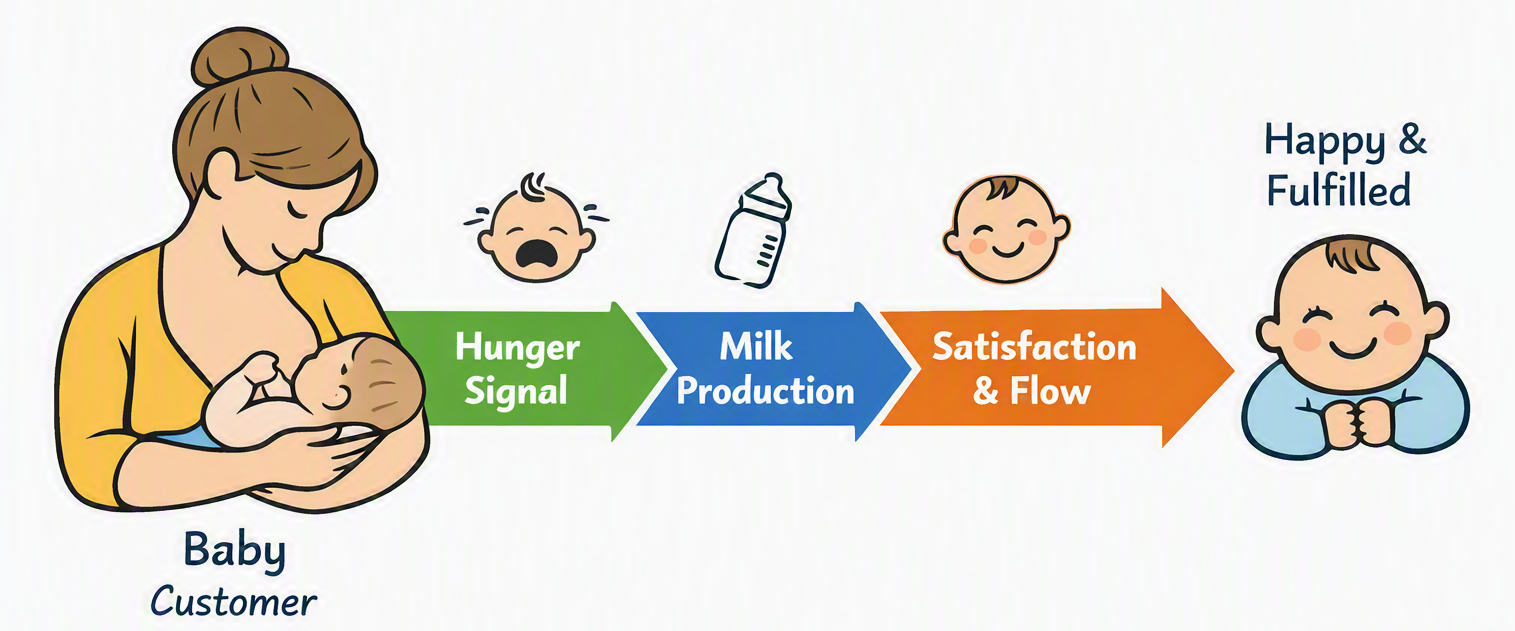
With exclusive, baby-led breastfeeding, the relationship between customer and production is remarkably simple.
The baby is the customer.
The mother’s body is the production system.
And the milk is the product.
There is no production schedule telling me how much milk to produce and when. Instead, there is a signal.
When my daughter is hungry, she feeds. Her demand provides the signal, and my body responds by producing milk.
In Lean terms:
Customer need → Signal → Production → Customer
The production is being pulled by the need, rather than pushed towards the customer.
The Customer Signal Comes First
One of the biggest challenges in creating a pull system is understanding the customer’s need correctly.
This is where we sometimes get it wrong in industry.
We focus heavily on what we are capable of producing:
How much can we make?
How quickly can we make it?
How efficiently can we run the process?
These questions are important, but they are not the starting point.
The starting point is:
What does the customer need, and how do we know?
In manufacturing, customer signals can come through orders, consumption, Kanban, replenishment signals, real-time demand or other forms of actual customer information.
The mechanism may change, but the principle remains the same:
Listen to the signal and respond to the need.
Your Production System Needs to Be Ready
Of course, responding to demand only works if the production system is capable of responding.
My body needs to be healthy and ready to produce. Nutrition, rest and overall wellbeing matter.
The same is true in manufacturing.
We need reliable equipment, stable processes, good quality, skilled people, effective maintenance, appropriate capacity and accurate information.
All of these create the capability to respond when the customer pulls.
But there is an important distinction:
A capable production system does not automatically create pull.
You can have an extremely efficient production line, but if you don’t understand customer demand, you can still produce the wrong thing, at the wrong time, or in the wrong quantity.
Production readiness is necessary.
Customer understanding creates the pull.
What Happens When We Push?
Imagine the opposite situation.
Instead of responding to my daughter’s signals, I decide that I should produce as much milk as possible, just in case she needs it.
I would be putting unnecessary pressure on my own body.
In Lean terms, this is where we can start to think about Muri — overburden.
The same happens in production systems.
When we produce without a clear demand signal, we can create overproduction, excess inventory, unnecessary work and additional pressure on people and equipment.
And overproduction can create even more waste: more storage, more movement, more handling, more potential defects and more working capital tied up in inventory.
We are essentially pushing the system rather than allowing the customer to pull.
Protect the System, Don’t Push It
This is why a good pull system is not about simply producing less.
It is about producing what is needed, when it is needed, while protecting the production system that makes it possible.
Your equipment needs maintenance.
Your processes need stability.
Your people need the right conditions.
Your information needs to be reliable.
Your system needs to be healthy and ready to respond.
But being ready does not mean constantly running at maximum capacity or producing “just in case”.
It means being prepared to respond when the customer signal arrives.
Watch the Signals
Customer demand is rarely completely static.
It can change with seasons, promotions, market conditions, new products, customer behaviour or unexpected events.
That means a pull system cannot simply be a Kanban card sitting between two processes.
We need to understand what the signals are telling us.
Are customers consuming more?
Less?
At a different time?
For a different reason?
The better we understand those signals, the better we can align production with actual demand.
And when production is aligned with demand, something quite simple happens:
We stop pushing and start responding.
When Pull Works, Everything Flows
And this brings me back to my little customer.
When my daughter is hungry, she gives me a signal. I respond, and my body produces what she needs, when she needs it.
If I try to produce more than she needs, I am simply putting unnecessary pressure on my own body — Muri, or overburden, in Lean terms.
The same applies to our production systems. We need to protect them, maintain them and keep them ready to respond — but we don’t need to constantly push them to produce more than the customer needs.
Watch the signal. Respond to the need. Don’t push the system unnecessarily.
When the pull is right, the baby is fed, the body is healthy, and everyone is happy.
The customer is happy. You are happy. And everything flows. 💛
Çekme Akışı: Emzirmenin Bana Yalın Düşünce Hakkında Öğrettikleri
Çekme akışı, sürekli iyileştirmenin en zor konularından biridir.
Çoğu zaman yanlış anlaşılır. Kavram doğru anlaşılsa bile, başarılı bir şekilde uygulanabilmesi için disiplin, istikrarlı süreçler ve güçlü bir sürekli iyileştirme kültürü gerekir.
Özellikle otomotiv sektöründeki deneyimimde, üretimin kendisini iyileştirmeye çok fazla odaklandığımızı gördüm: kapasiteyi artırmak, verimliliği yükseltmek, duruşları azaltmak ve daha hızlı üretmek.
Oysa bundan önce sormamız gereken başka bir soru var:
Müşteri gerçekten neye ihtiyaç duyuyor?
İlginç bir şekilde, anne olmak bana bu konuya bambaşka bir açıdan bakmayı öğretti.
Bir Bebekten Çekme Akışını Öğrenmek
Yeni bir anne olarak, kızımı emzirdiğim zamanlarda çekme akışı üzerine düşünmeye başladım.
Özel olarak emzirme sürecine baktığınızda, müşteri ile üretim arasındaki ilişki aslında şaşırtıcı derecede basittir.
Bebek müşteridir.
Annenin bedeni üretim sistemidir.
Ve süt üründür.
Ne kadar süt üretmem gerektiğini ve ne zaman üretmem gerektiğini söyleyen bir üretim planım yok.
Bunun yerine bir sinyal var.
Kızım acıktığında emiyor. Onun ihtiyacı bir sinyal oluşturuyor ve vücudum bu ihtiyaca cevap vererek süt üretiyor.
Yalın düşünce açısından baktığımızda:
Müşteri ihtiyacı → Sinyal → Üretim → Müşteri
Üretim müşteriye doğru itilmek yerine, ihtiyaç tarafından çekiliyor.
Önce Müşteri Sinyalini Anlamak
Çekme sistemi oluşturmanın en büyük zorluklarından biri, müşterinin ihtiyacını doğru anlamaktır.
Endüstride de zaman zaman burada hata yapıyoruz.
Üretme kapasitemize çok fazla odaklanıyoruz:
Ne kadar üretebiliriz?
Ne kadar hızlı üretebiliriz?
Prosesi ne kadar verimli çalıştırabiliriz?
Bunların hepsi önemli sorular. Ancak başlangıç noktası bunlar değil.
Başlangıç noktası şu olmalı:
Müşteri neye ihtiyaç duyuyor ve bunu nasıl biliyoruz?
Üretimde müşteri sinyalleri; siparişler, tüketim, Kanban, yenileme sinyalleri, gerçek zamanlı talep veya müşteriden gelen diğer gerçek veriler aracılığıyla oluşabilir.
Sinyalin şekli değişebilir, ancak temel prensip değişmez:
Sinyali dinle ve ihtiyaca cevap ver.
Üretim Sisteminiz Hazır Olmalı
Elbette talebe cevap verebilmek için üretim sisteminin de buna hazır olması gerekir.
Benim bedenimin sağlıklı ve üretime hazır olması gerekir. Beslenme, dinlenme ve genel sağlık önemlidir.
Üretimde de durum aynıdır.
Güvenilir ekipmanlara, istikrarlı proseslere, kaliteli üretime, yetkin çalışanlara, etkili bakıma, uygun kapasiteye ve doğru bilgiye ihtiyacımız vardır.
Bunların hepsi, müşteri çektiğinde cevap verebilmemizi sağlayan üretim kapasitesini oluşturur.
Ancak burada önemli bir ayrım var:
Kapasitesi yüksek ve iyi çalışan bir üretim sistemi, tek başına çekme sistemi oluşturmaz.
Son derece verimli bir üretim hattınız olabilir. Ancak müşteri talebini anlamıyorsanız yine de yanlış ürünü, yanlış zamanda veya yanlış miktarda üretebilirsiniz.
Üretim sisteminin hazır olması gereklidir.
Ancak çekme akışını yaratan, müşteriyi anlamaktır.
İttiğimizde Ne Olur?
Şimdi bunun tam tersini düşünelim.
Kızımın verdiği sinyallere cevap vermek yerine, “Ne olur ne olmaz, mümkün olduğunca fazla süt üretmeliyim” diye düşündüğümü varsayalım.
Bu durumda kendi bedenime gereksiz bir yük bindirmiş olurum.
Yalın düşünce açısından baktığımızda burada Muri — aşırı yüklenme kavramını görebiliriz.
Üretim sistemlerinde de benzer bir durum ortaya çıkar.
Net bir talep sinyali olmadan üretim yaptığımızda; aşırı üretim, gereksiz stok, gereksiz iş ve insanlar ile ekipmanlar üzerinde ek baskı yaratabiliriz.
Üstelik aşırı üretim başka israfları da beraberinde getirebilir: daha fazla depolama, taşıma, elleçleme, potansiyel kalite problemleri ve stokta bağlı kalan daha fazla sermaye.
Yani sistemi çekme yerine itmeye başlarız.
Sistemi Koru, Zorlamaya Çalışma
İyi bir çekme sistemi, sadece daha az üretmek anlamına gelmez.
Asıl mesele, ihtiyaç olanı, ihtiyaç olduğu zamanda üretirken bunu mümkün kılan üretim sistemini korumaktır.
Ekipmanlarınızın bakıma ihtiyacı vardır.
Proseslerinizin istikrarlı olması gerekir.
Çalışanlarınızın doğru çalışma koşullarına ihtiyacı vardır.
Bilginizin güvenilir olması gerekir.
Sisteminizin sağlıklı olması ve müşteri sinyaline cevap vermeye hazır bulunması gerekir.
Ancak hazır olmak, sistemi sürekli maksimum kapasitede çalıştırmak veya “ne olur ne olmaz” diye üretmek anlamına gelmez.
Hazır olmak, müşteri sinyali geldiğinde cevap verebilecek durumda olmak demektir.
Sinyalleri İzleyin
Müşteri talebi nadiren tamamen sabittir.
Mevsimlere, kampanyalara, pazar koşullarına, yeni ürünlere, müşteri davranışlarına veya beklenmedik olaylara bağlı olarak değişebilir.
Bu nedenle çekme sistemi, iki proses arasında duran bir Kanban kartından ibaret olamaz.
Sinyallerin bize ne söylediğini anlamamız gerekir.
Müşteriler daha fazla mı tüketiyor?
Daha az mı?
Farklı bir zamanda mı ihtiyaç duyuyor?
Farklı bir sebeple mi?
Bu sinyalleri ne kadar iyi anlarsak, üretimi gerçek talebe o kadar iyi hizalayabiliriz.
Üretim talep ile hizalandığında ise çok basit bir şey gerçekleşir:
İtmeyi bırakır, cevap vermeye başlarız.
Çekme Olduğunda Her Şey Akmaya Başlar
Ve bu beni tekrar küçük müşterime getiriyor.
Kızım acıktığında bana bir sinyal veriyor. Ben bu sinyale cevap veriyorum ve bedenim ihtiyaç duyduğu anda, ihtiyacı kadar üretim yapıyor.
İhtiyacından fazlasını üretmeye çalışırsam, kendi bedenime gereksiz bir yük bindirmiş olurum — Yalın Düşünce’deki karşılığıyla Muri, yani aşırı yüklenme.
Üretim sistemlerimiz için de aynı şey geçerli. Sistemlerimizi korumamız, bakımlarını yapmamız ve müşteri sinyaline cevap vermeye hazır tutmamız gerekir. Ancak müşterinin ihtiyacından fazlasını üretmesi için sistemi sürekli zorlamamız gerekmez.
Sinyali izle. İhtiyaca cevap ver. Sistemi gereksiz yere zorlama.
Çekme doğru çalıştığında bebek beslenir, beden sağlıklı kalır ve herkes mutlu olur.
Müşteri mutlu. Sen mutlusun. Ve her şey akıyor. 💛